Expanding your ecommerce business into the Middle East and North Africa (MENA) requires more than translation. It requires strategic Arabic ecommerce localization built for buyer trust, conversion performance, and regional nuance.
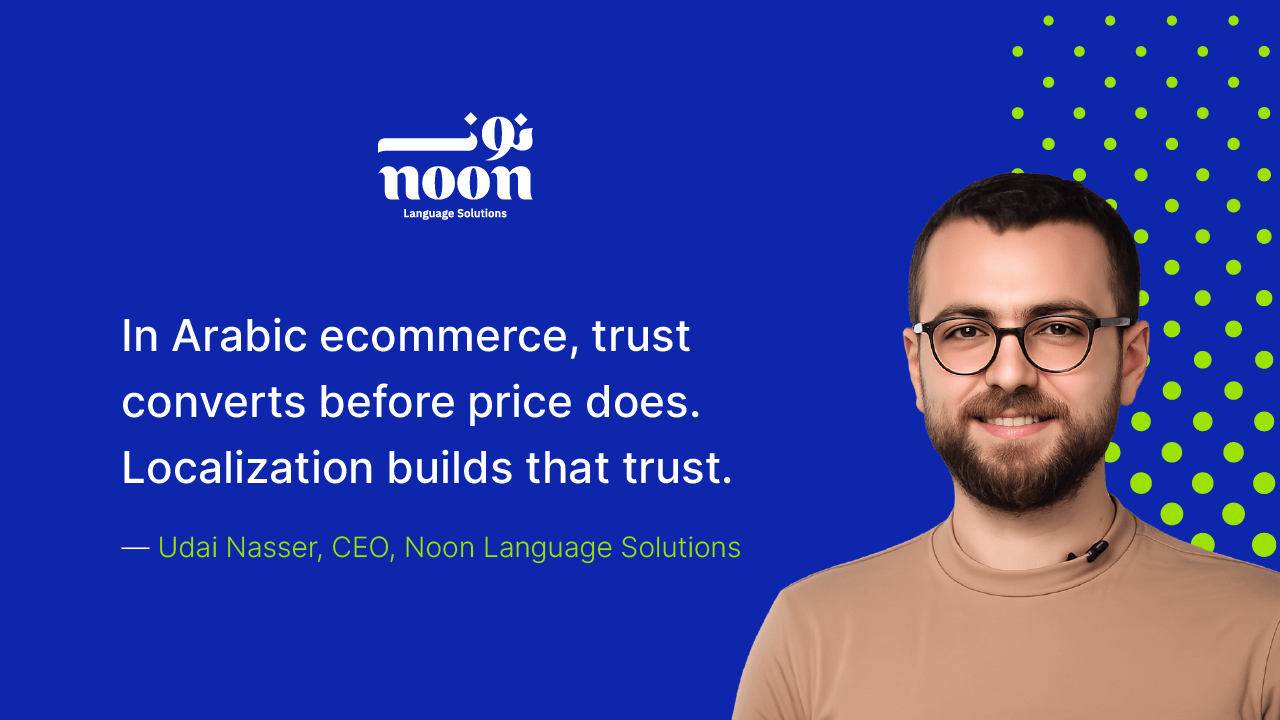
In this executive interview, Mr. Udai Nasser, CEO of Noon Language Solutions, shares operational insights gathered from over a decade of localizing ecommerce websites and applications across Saudi Arabia, UAE, Qatar, Kuwait, Egypt, and the wider MENA region. This article combines commercial guidance with structured internal audit data collected between 2024–2025.
Professional Arabic Ecommerce Localization Services for MENA Markets
Before diving into the interview, it’s important to clarify: Arabic ecommerce localization services are not linguistic tasks—they are revenue protection mechanisms.
Brands entering MENA require:
- RTL (Right-to-Left) technical remapping for web and apps.
- Product terminology governance to eliminate buyer hesitation.
- Measurement and size conversion to reduce return rates.
- Conversion-focused Arabic UX validation.
Noon Language Solutions provides a hybrid AI + human Arabic ecommerce localization model designed specifically for MENA expansion.
CEO Interview with Mr. Udai Nasser
Q1: What makes Arabic ecommerce localization different from other regions?
Mr. Udai Nasser: The biggest misconception is that Arabic ecommerce localization is simply translation plus “flipping” the layout. Actually, it isn’t.
Between January 2024 and December 2025, we conducted structured QA audits across 87 ecommerce platforms entering MENA markets— including fashion, electronics, automotive, and high-end retail.
We identified four recurring structural risks that directly leak revenue:
1. RTL Technical Localization Is a Conversion Factor
Arabic is written Right-to-Left. But true RTL ecommerce localization goes beyond flipping layout.
It impacts:
- UI mirroring
- Icon directionality
- Filter logic
- Product variation displays
- Checkout alignment
Our audit findings across 87 ecommerce interfaces showed that:
- 29% had misaligned interactive elements after basic RTL adaptation
- 17% had checkout friction caused by partial mirroring
- 11% suffered mobile truncation due to Arabic word expansion
Arabic text typically expands 15–30% compared to English. If not accounted for during localization, buttons break, banners overflow, and mobile UX deteriorates. UX deterioration directly affects conversion.
2. MSA vs Dialect Impacts Revenue, Not Just Tone
Choosing between Modern Standard Arabic (MSA) and regional dialect is a commercial decision. In A/B testing projects for two fashion brands entering GCC markets:
- Standardized MSA improved trust perception metrics in luxury segments
- Selective dialect adaptation increased engagement for youth fashion categories
- Terminology harmonization increased add-to-cart rate by 14% within 60 days ( June and July 2025).
The key insight here: Arabic ecommerce localization must align with brand positioning. Luxury brands need authority. Youth brands need relatability. Translation without audience calibration reduces performance. In many cases, brands must choose between localization and transcreation, making it important to evaluate transcreation vs localization in MENA to achieve real audience relatability.
3. Product Terminology Gaps Create Buyer Hesitation
Arabic is linguistically rich, but many modern product categories lack direct equivalents:
- Smart device features
- Technical specs
- Fashion cut styles
- Automotive system labels
Our terminology audits across tens of ecommerce product catalogs showed that:
- 41% had inconsistent naming for identical product features
- 26% mixed transliteration and translation randomly
- 19% created ambiguity in technical descriptions
The key insight here: Ambiguity increases hesitation. Hesitation increases cart abandonment. Professional Arabic ecommerce translation services must include terminology governance — not just translation delivery.
4. Measurement Localization Is One of the Most Expensive Mistakes
Unit and measurement errors are among the most damaging localization failures.
In our 2024–2025 analysis;
- 34% of ecommerce sites entering MENA had inconsistent apparel sizing adaptation
- 22% mislocalized weight or dimension units
- 18% showed currency formatting inconsistencies
For one fashion retailer, clarifying size equivalency and standardizing product measurement labels reduced return requests by 26% over one quarter.
Localization errors in units are not linguistic errors. They are revenue leaks.
Q2: What Do Arabic-Speaking Online Buyers Care About Most?
Mr. Udai Nasser: Simply, it is trust and consistency. Arabic ecommerce buyers are cautious decision-makers. Through behavioral feedback and project performance tracking during our mentioned audit, we observed that buyers actively verify:
- Terminology repetition
- Spec consistency
- Delivery timeline clarity
- Warranty language precision
- Delivery and/or other hidden fees transparency
In Arabic ecommerce markets, inconsistency signals risk. Risk reduces checkout completion.
That is why conversion-focused Arabic ecommerce localization must include:
- Centralized terminology databases
- Cross-page QA validation
- Tone alignment across product families
- Localization becomes a trust-building infrastructure.
Q3: Is AI Enough for Ecommerce Localization into Arabic?
Mr. Udai Nasser: AI has significantly improved operational efficiency.
Over the past year 2025, our hybrid workflow metrics showed:
- 40% faster delivery timelines using AI-assisted workflows
- 20% reduction in surface-level linguistic errors
- 10% improvement in terminology consistency
However, our QA showed AI-only workflows still have limitations;
- Tone misalignment in 32% of luxury ecommerce descriptions
- Context misinterpretation in high-spec electronics listings
- Inconsistent handling of dialect-sensitive categories
Ecommerce content is purchase-decision content. Unlike entertainment localization, ecommerce errors directly affect revenue. If MENA based buyer sense robotic tone or feels uncertain about model version, size, specification, or price clarity, the buying experience collapses immediately.
So the clear answer to your question is; AI is an accelerator. It is not a replacement for human-led MENA ecommerce localization expertise. That is why we operate a hybrid Arabic ecommerce localization model.
Q4: What Is the Most Overlooked Strategic Mistake?
Mr. Udai Nasser: Treating localization as a post-launch translation task instead of a market-entry strategy.
Many brands:
- Build English UX
- Duplicate layout
- Add Arabic translation
- Launch
But effective Arabic ecommerce localization for Saudi Arabia, UAE, Qatar, Kuwait, Egypt, and the wider MENA markets must integrate at design stage:
- UX direction logic
- Size conversion systems
- Currency formatting rules
- Terminology frameworks
- Cultural tone positioning
When localization is embedded early, rework cost decreases and launch performance stabilizes.
Q5: Who Needs Professional Arabic Ecommerce Localization Services?
You need expert ecommerce translation into Arabic if you:
- Are launching Shopify, Magento, or custom ecommerce into GCC
- Build an application or platform with checkout functionality aimed for MENA markets, or require scalable Arabic app localization for ecommerce.
- Experience high cart abandonment in Arabic versions
- Sell luxury fashion, electronics, automotive, or high-ticket items.
Q6: How Does the Hybrid Arabic Ecommerce Localization Work?
As a specialized Arabic ecommerce localization company for MENA with over 10 years of experience, we at Noon Language Solutions apply our own hybrid Arabic ecommerce localization model:
- AI-assisted first-pass translation
- Vertical-specialized ecommerce linguists
- Dedicated RTL UI validation
- Terminology database management
- Conversion-focused linguistic QA
This ensures:
✔ Accurate product descriptions
✔ Proper measurement localization
✔ Dialect-appropriate tone
✔ Technical RTL integrity
✔ Commercial alignment with GCC and other MENA buyers
Does Your Ecommerce Platform Need Arabic Localization?
If your brand is preparing to scale into the Middle East and requires a trusted Arabic ecommerce localization partner, we at Noon Language Solutions deliver conversion-oriented localization services, combining AI efficiency with vertical-specialized linguists.